
Table of Contents
Choosing an Addiction Treatment Center in New Jersey
Currently, if you look for a treatment facility in NJ then you should also see that the state is making mandatory its insurance cover for up to six months’ worth of both inpatient as well as out patient care. Besides being mandated for up to six months, the state has fixed five days on first prescription for acute pain for opioids. And prescribers must acquire a single CME credit bi-yearly about addiction to opioids. The quality treatment centers offer entire continuum of care and transition plans moving patients from inpatient setting to outpatient facilities. They also provide quick intake (typically inside a period of 24 hrs), and person centered clinical solutions along with community support link ups. Taylor Care exemplifies this model. With its person-centred programmes, it directly partners together with Northbrook and Buttonwood Behavioral Health Hospital. It pledges to assist in the change by providing tools and abilities that empower them to find control over their lives and achieve independence and self-determination. With such legislation in place to protect people and set clinical benchmarks for the best treatment programs, we’re prepared to start helping our consumers plan their addiction treatments.
Preparing for Your Addiction Treatment Search
If you want to stop using drugs then treatment needs to involve some type of intervention that has proven to work based on research.
When looking for a treatment facility, make sure you inquire whether they provide any complimentary transport options or nutritious meal plans that can help reduce your daily worries while in treatment.
According to the American Society of Addiction Medicine (ASAM) and the New Jersey Society of Addiction Medicine (NJSAM), New Jersey legislation requires insurers to cover up to six months of inpatient and outpatient addiction treatment. You should confirm with your particular provider which treatment(s) they will cover under your policy so as to better determine what types of treatment may be provided within your plan. There are two typical levels of care available – Intensive Outpatient Therapy (IOP), and regular Outpatient Care. IOP features more intensive attention to patients for three days each week in order to allow sufficient time during the morning, afternoon and night hours to meet requirements for work or family life. Individuals seeking Outpatient Care prefer this form because it enables them to continue living normal lives while still getting help for their addictions. Many programs will incorporate all core services into a package including individual counselling sessions, group therapy meetings, psychiatric evaluations, and medication assisted treatment.
Preparation for contacting organizations and determining eligibility starts with gathering basic information from yourself. Before making inquiries, review your insurance policy, assess how much assistance you will need and what kinds of services you’ll need to have in order to choose which program should help you.
Step 1: Assess Your Personal Recovery Needs
Our intake schedules take place within 24 hours following any referrals that have been made. The locations in our Tuckerton and Berlin facilities service the entire area of Ocean, Burlington, Camden, Gloucester and more nearby counties. Now that you have this knowledge at your disposal, it’s time for you to start focusing on what your exact needs may be while looking to achieve full recovery. It all starts with getting out of your comfort zone as soon as possible by making that first call for help.
Instructions
We offer treatment options ranging from Partial Care, which includes daily programming, to Intensive Outpatient services that provide several hours of support weekly, and Standard Outpatient, where clients visit less frequently. Jot down your substance use pattern, triggers, and any co-occurring mental health symptoms such as anxiety or depression. Providing this information to an intake coordinator makes your assessment more accurate and efficient.
Why This Matters
Here, we give you all the information on your options, and now you need to decide how much sense these make for you in reality.
Tips
We’ll match the intensity of therapy to what you can manage in terms of clinical need. Taylor Care gives your clients a safe space for therapy in which to find hope and self-respect as they progress through their recovery programme.
Write down what kinds of drugs you’ve taken and when, as well as any other problems such as anxiety, depression etc. It will help us to make up a treatment plan that suits you.
Step 2: Verify Your Insurance and Payment Options
Instructions
Let us know when you are ready for your next practical step, which can be making sure what kind of insurance and money plans you have.
Step 2: Verify Your Insurance and Payment Options
Instructions
Contact your insurance provider to find out if this is covered on your plan for behavioral health issues. We accept NJ Medicaid as well as many other commercial plans – please review your benefits coverage to see what is available for you related to substance abuse and mental health services. According to The American Society of Addiction Medicine in NJ, State Law requires insurers to cover addiction treatment for up to six months which means we can offer long term services here.
Why This Matters
Financial surprises may make it difficult for you to continue on with your recovery plan. Having already verified that you receive benefits removes any worries that you will have to stop therapy because of unanticipated costs. Knowing what you can afford also helps you avoid being put under pressure if some unexpected bills arrive. Taking advantage of this now allows you to move forward without hindrance.
Tips
Make sure that the insurance carrier will permit payment for the therapy before you start getting it. Ask how much your coinsurance will be. Should any conditions have been laid down then see whether other options might still be open to you. Get as many assurances as possible about this since once they’re provided, things may proceed at speed. Having made certain that your treatment was paid, consider all types of treatment you should get according to the specific needs of yours.
Step 3: Compare Treatment Services and Modalities
Instructions
When considering an addictions treatment center make sure you look at what type of services it has available. These include individual therapy, group counseling, family counseling, medication-assisted treatment, case management, etc. Each of the centers will have their own particular method for incorporating these services within their overall program. Additionally ensure there’s more than just one level of care offered like IOP, PHP and Outpatient.
Why This Matters
With a true continuum of care, your level of care can be modified as needed without having to change providers. Because our program offers PHP, IOP, and Standard Outpatient levels of care, patients will always have some sort of therapeutic intervention going on while also receiving care from the same team consistently.
Tips
When you’re considering treatment plans such as CBT (Cognitive Behavioral Therapy), DBT (Dialectical Behavior Therapy) or TIC (Trauma Informed Care), be sure that any plan has a means for managing the patient’s psychiatric issues without relying on medications. A recent waiver from the New Jersey DOH allows for some treatment plans to utilize tele-health screening, in conjunction with more flexible drug plans.
Step 4: Evaluate Evidence-Based Treatment Approaches
Upon examining all possible treatments that can be provided, you will then proceed to examine which form of research based techniques used in your client’s therapy plan.
Instructions
Drug addiction treatment must incorporate interventions which have been shown in research studies to work effectively. It is essential to determine whether the program uses several forms of therapy depending upon existing evidence.
- CBT and DBT
- Motivational interviewing and trauma-informed therapy
- Integrated dual diagnosis treatment
- MAT with counseling and medication management
Why This Matters
There’s always some type of core therapies that might be available like CBT, DBT, MI, Trauma-informed care, etc. Taylor Care offers these:
Tips
There were clinical tests conducted in this area so that people could better predict its success rates. By sticking to effective treatment techniques, you won’t waste away all of your time and money trying various methods that don’t work.
Tell the medical professionals what works and doesn’t work for you, if they aren’t making improvements. If an organization is using evidence-based procedures, it should modify its approach accordingly to match your situation better.
Step 5: Check Facility Credentials and Reputation
Instructions
If your center uses methods based on scientific research and facts, be certain that it has a valid license as well as a professional certification. Ensure also that the institution meets all the necessary standards for legitimacy.
Why This Matters
First you will want to review what licenses your center holds and any other accreditations they may have. Then look at their staffing pool – if there are licensed therapists, physicians or other mental health providers available. Also take time to read about the hospitals associated with each treatment center. Some allow for intake in as quickly as 24 hours such as Buttonwood and Northbrook where we coordinate our care, some centers can see patients that quick.
Step 6: Consider Practical Supports and Local Accessibility
Care provided at good quality healthcare centres may assist you from receiving poor quality healthcare service or dangerous health care services. It would give assurance as to the fact that the health treatment team are following best practices as well as being responsible to regulatory body.
Instructions
Seek information pertaining to discharge plans and any form of post-treatment care that may be made available as well. Facilities who provide coordination for services between various treatment providers demonstrate their readiness to ensure that their clients continue obtaining the proper care even after they have left said center. Make sure your facility of choice meets all your qualifications prior to diving into the mundane issues such as modes of transport or localized accessibilities.
Why This Matters
Make sure you inquire about things like transportation or meals that don’t put unnecessary strain on your daily routine if you choose a treatment center.
Tips
The center serves people in Ocean, Atlantic and Burlington Counties as well as other nearby places and offers its participants healthy food during its day program. If you want to enroll a local person check first if there’s any facility location near them before calling us at Tuckerton, Berlin and Galloway. We recommend you ask for schedules when signing up since this care provider operates on weekdays from 8:30 AM to 3:25 PM.
Step 7: Prepare for the Intake Process
Continuous therapy leads to improved outcomes for therapy. They found out that frequent visits had more treatment success rate.
Instructions
If you’re from Tuckerton, Berlin, Galloway, Manahawkin or other places then contact us about the transport radius. First, let’s find out if there are any work commitments or family obligations that would affect your daily schedule so as to create an optimal plan. Once that’s done, we will guide you on how to proceed towards our intake program.
Why This Matters
Once you make a plan on how to transport everyone to places and find locations of all events taking place in this session, then you need to be prepared for this specific first meeting of it all.
Tips
Make sure that you bring these items when coming in: photo id, insurance cards, a list of all meds you currently take, and any relevant medical records. We usually spend around 60 – 90 mins for this process because we do lots of assessments, go through history, start making plans and goals for your care, etc. These appointments can be scheduled within 24 hours but often we’ll get you in on the same day if possible.
Overcoming Barriers to Accessing Addiction Treatment
No more worry, only time for your first step to recovery. That will be our main objective if you decide to participate in this programme. The intake process takes no more than 24 hours to complete and we then know exactly where things stand. This makes it far less likely that anything will hold up progress towards your personal goals, saving you stress during what should already be quite difficult time.
Write down any issues you want addressed in therapy before going there, set up times when someone can see you without others around, discuss your privacy policy with them, involve your family as needed, arrange time for group sessions, and bring someone with you if you feel insecure about meeting strangers on your own. Be prepared and ready to receive the necessary help during this initial phase.
Many drug addicts delay going into rehab because they don’t want to or can’t afford to pay for treatment, there isn’t enough capacity available at clinics or hospitals nearby, or public transport connections in the area are too bad.
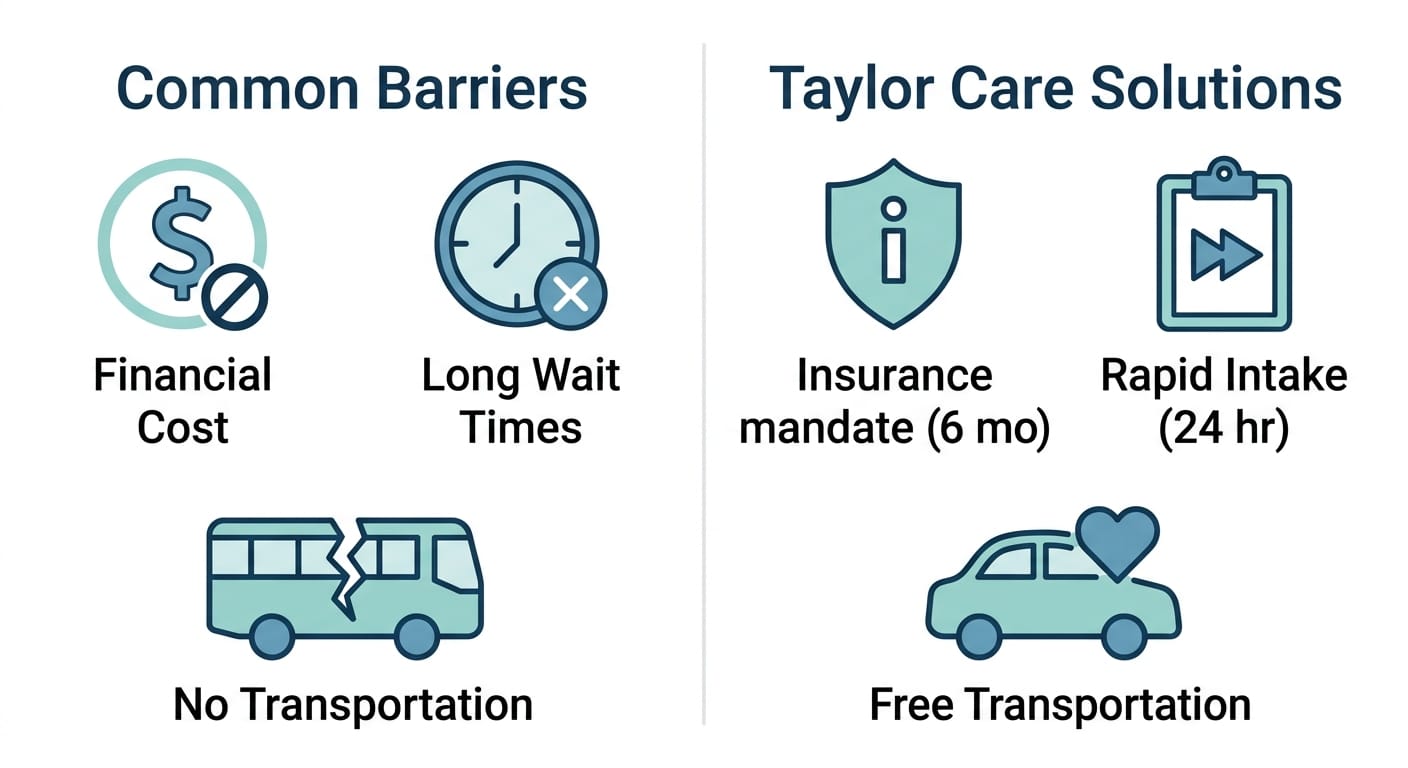
The NJ law that recently became effective was reviewed by ASAM and requires insurers to cover up to six months of inpatient and outpatient addiction treatment, as well as limits initial opioid prescription for acute pain to only five days. The first part helps tackle the issue of financial barriers, making it much simpler for patients living down south in New Jersey to access all forms of therapy without having to worry too much about money. The other side of this law aims at preventing more drug addictions from occurring, while encouraging patients to get help earlier if they’re in need due to their pain.
Taking the First Step Toward Recovery with Taylor Care
If you’re ready to begin the journey toward sobriety, Our addiction treatment center in New Jersey can help offer a person-centered continuum of care tailored to your needs. Programs include intensive outpatient services as well as structured support for transitions from residential facilities. We’ll see you within 24 hours of getting referred to us, although we will also perform same-day intake if needed based on clinical criteria. We provide free transportation to all program locations across seven South Jersey counties, which helps remove another hurdle.
Refer yourself via our online referral system or call our Tuckerton office at (609) 879-2233. This referral system is not intended for emergency situations. In case of a medical emergency, dial 9-1-1. Individual treatment options and outcomes can be different from one individual to another due to different health conditions or clinical conditions that will impact your own response. Consult a healthcare professional to talk about your personal condition before proceeding any further. Insurance coverage must be verified with each carrier, even though we offer some ways to verify insurance information for patients; however, the ultimate responsibility still belongs to the carrier or insured patient themselves.
Start Your Recovery Today
We provide practical help at this point based on the legal protection that has been set up for us. Intakes can be arranged within 24 hours of a referral arriving and if it is necessary they will happen same day if there is any medical issues involved. We give free transportation to anywhere across our seven county service area in South Jersey. This makes a big difference when getting started because it removes a huge logistical hurdle. We try to help our clients move their care levels up and down based on what type of intervention they need at a given time. Our model for a continuum of care runs the gamut from Intensive Outpatient Therapy and goes downward into other more basic lower level interventions. Participants receive a lot of different treatments during the course of participation some include Psych evals and Medication-Assistive Treatment in order to get their different needs met.
This combination of law and common sense has made obtaining assistance easier for those in South Jersey. With our guidance now having been laid out, we can assist them on their journey towards recovery.
Now that you’ve completed the step-by-step guide for choosing an addiction treatment center in NJ, it’s time to put what you’ve learned into practice. Our program includes a person-centered continuum of care, fast scheduling within 24 hours, and free transport options to get rid of some of the barriers to treatment. You’ll also have access to a safe, easy-to-use referral portal where you can enter all your info and make the intake process quick and easy. We’re based in Tuckerton, Berlin, and Galloway, serving many different parts of South Jersey. How to look at yourself for your individual needs, check on your insurance status, and consider the evidence-based treatment options available to you. What’s next? Use our referral portal to take your first steps towards personal recovery, as your new life starts here. We’re going to help you along the road to a better future.
Resources
Frequently Asked Questions
What insurance coverage is available for addiction treatment in New Jersey?
Insurance providers must cover up to six months of inpatient as well as outpatient therapy for drug abuse in New Jersey. The insurance carrier has got to be contacted in order for you to see if they’ll pay toward these expenses within the behavioral health element of your own policy.
How quickly can I get into a treatment program?
Some quality treatment center options located near New Jersey provide speedy intake that generally occurs within 24 hours of admission so the patient can begin his recovery right away.
What should I look for when choosing an addiction treatment center?
If you’re considering getting help for substance abuse disorders, take time out to explore what makes sense in terms of personal recovery needs. Figure out how to get help if you don’t have insurance, understand other payment options available, research treatment options, find those that fit your criteria as evidenced by research studies, learn about treatment providers’ credentials/reputations, discover where they can be located within walking distance if necessary, etc…
What is a continuum of care in addiction treatment?
Continuous treatment facility must be all inclusive when dealing with patients transitioning their level of care from hospitalization to home based rehabilitation. This would mean patient will not lose out on their continued recovery while moving down this road.